Watch the video at the end of this article.
Introduction
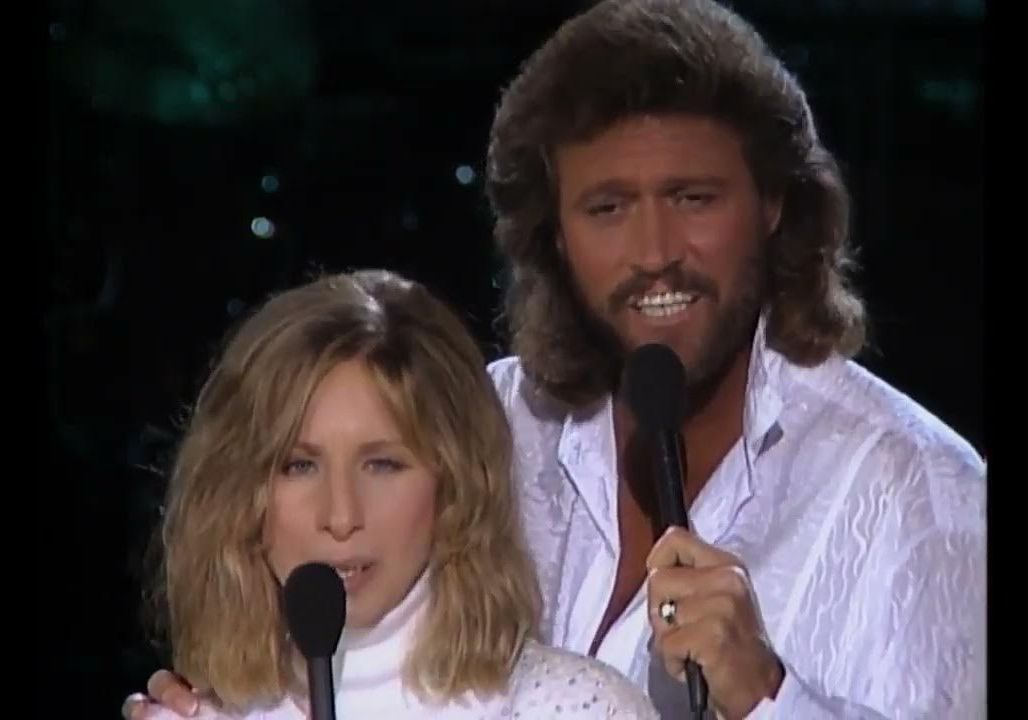
In the history of televised live music performances, few moments have reached the emotional and artistic height of the 1986 HBO special featuring Barbra Streisand and Barry Gibb performing their iconic duet Guilty. It was more than just a song being performed on stage; it was the convergence of two extraordinary musical worlds—Streisand’s theatrical brilliance and emotional vocal precision meeting Gibb’s signature falsetto and understated pop sophistication. The result was a performance that felt intimate, cinematic, and almost suspended in time, as if the entire audience had been invited into a private emotional conversation between two legends.
The song itself, already beloved as a polished pop masterpiece, gained new depth in this live interpretation. On stage, Streisand brought a commanding yet vulnerable presence, shaping every phrase with operatic control and expressive nuance. Her voice did not simply sing the melody; it narrated the emotional tension of love, regret, and devotion embedded in the lyrics. Opposite her, Barry Gibb stood as the perfect counterbalance—restrained, elegant, and emotionally transparent. His falsetto floated above the arrangement like a soft light, never overpowering, always complementing, creating a harmonic dialogue that felt both spontaneous and carefully refined.
What made this performance especially unforgettable was the chemistry between the two artists. There was no sense of competition or vocal dominance. Instead, there was trust—an unspoken understanding that allowed each to shine while elevating the other. The stage direction of the HBO production enhanced this intimacy, using soft lighting, warm tones, and minimal distractions so that the audience could focus entirely on the emotional exchange unfolding between them. Every glance, every breath, and every subtle shift in phrasing contributed to a sense of storytelling that went beyond music.
Musically, the arrangement supported this emotional weight with elegant restraint. The instrumentation remained smooth and unobtrusive, allowing the vocals to sit at the forefront. Gentle keyboards, soft percussion, and lush harmonies created a soundscape that felt luxurious yet deeply personal. Rather than building toward spectacle, the performance leaned into intimacy, proving that simplicity can often deliver the most powerful impact when handled by artists of this caliber.
Over time, this rendition of “Guilty” has become a reference point for what a perfect duet can achieve. It is frequently revisited by fans and critics alike as an example of balance in performance—where two distinct artistic identities merge without losing individuality. The emotional resonance of the moment has only deepened with age, as newer generations discover the performance and are struck by its sincerity in an era often defined by production excess.
Beyond its technical brilliance, the performance endures because it feels human. It captures vulnerability, admiration, and connection in a way that transcends genre or era. When Streisand and Gibb share that stage, they are not just performing a song—they are embodying the emotional truth of it. Decades later, it remains a shining example of how music, when delivered with authenticity and mutual respect, can still give audiences chills and remind the world why live performance is an irreplaceable art form.