Watch the video at the end of this article.
Introduction
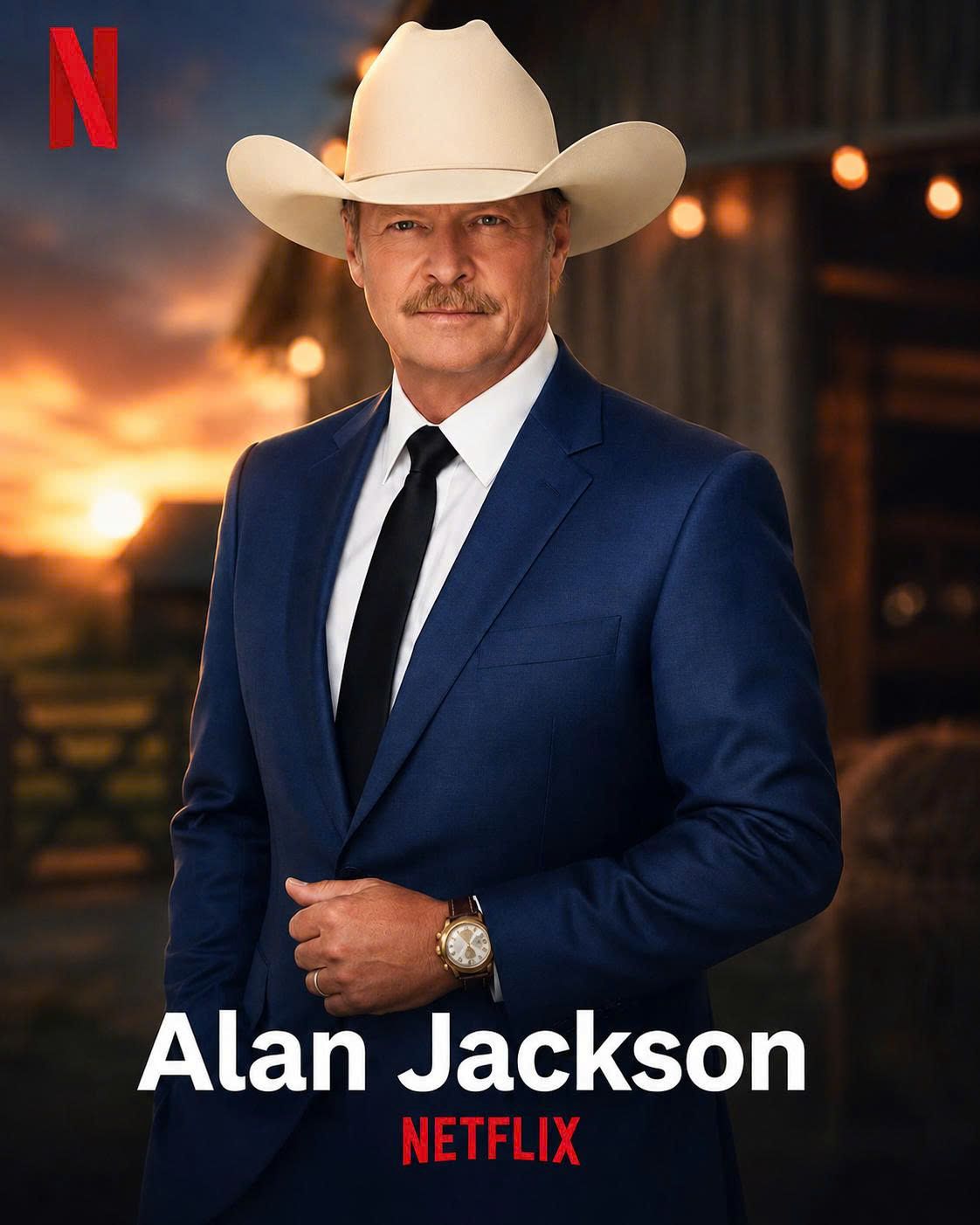
Alan Jackson has never needed spectacle to make an impact. For more than three decades, his power has come from something far simpler: an unmistakable voice, an honest lyric, a steel guitar, and the quiet confidence of a man who never seemed interested in becoming anything other than himself. “A Legacy That Lives On” captures that spirit beautifully, presenting Jackson not merely as a superstar, but as one of country music’s most enduring guardians—a “quiet giant” whose influence can still be heard in the songs, stories, and values that define the genre.
The portrait begins where Jackson’s story truly began: Newnan, Georgia. Long before the awards, packed arenas, and Nashville recognition, he was shaped by family, faith, hard work, and the everyday rhythms of Southern life. Those roots would later become the emotional foundation of his songwriting. Jackson’s songs rarely depended on complicated ideas. Instead, he found meaning in ordinary moments: young love, family memories, small towns, heartbreak, growing older, and the bittersweet realization that time moves faster than we expect.
When Here in the Real World arrived in 1990, Jackson immediately established himself as an artist deeply connected to traditional country music. While Nashville continued evolving commercially, he remained loyal to fiddle, steel guitar, memorable melodies, and straightforward storytelling. That commitment was never nostalgia for nostalgia’s sake—it was his artistic identity. Songs such as “Don’t Rock the Jukebox,” “Chattahoochee,” “Gone Country,” “Drive (For Daddy Gene),” and “Remember When” proved that traditional country could remain fresh, deeply personal, and universally relatable.
Perhaps no moment revealed Jackson’s gift for quiet emotional truth more powerfully than “Where Were You (When the World Stopped Turning).” Written after the September 11 attacks, the song did not attempt to provide grand answers. Instead, it asked simple questions and gave listeners room to experience grief, confusion, compassion, and faith. Its restraint became its strength, ultimately earning major honors and becoming one of the defining songs of Jackson’s career.
Yet “A Legacy That Lives On” becomes most moving when it looks beyond trophies and chart records. Jackson’s greatness has always been connected to the man beneath the white cowboy hat. His marriage to Denise, devotion to family, faith, and the personal sacrifices accompanying fame give his music deeper meaning. His reserved personality makes the story even more affecting. He never built his image around controversy or constant self-promotion; he simply kept writing songs that felt lived-in, honest, and true.
Jackson’s achievements are enormous. He was inducted into the Country Music Hall of Fame in 2017 after building a career that carried traditional country music into a new century while remaining remarkably faithful to its roots. But statistics alone cannot explain why his music still matters.
His true legacy lives in the way “Remember When” can make couples reflect on decades spent together, or how “Drive” can return listeners instantly to memories of parents, childhood, and moments they thought they had forgotten.
That is why Alan Jackson remains country music’s quiet giant. He did not chase every trend or demand the spotlight. He trusted the songs. He trusted tradition. And above all, he trusted that honesty would last.
“A Legacy That Lives On” ultimately reminds us that legends are not created by fame alone. They are created when music becomes part of people’s lives—and Alan Jackson’s music has done exactly that.