Watch the video at the end of this article.
Introduction
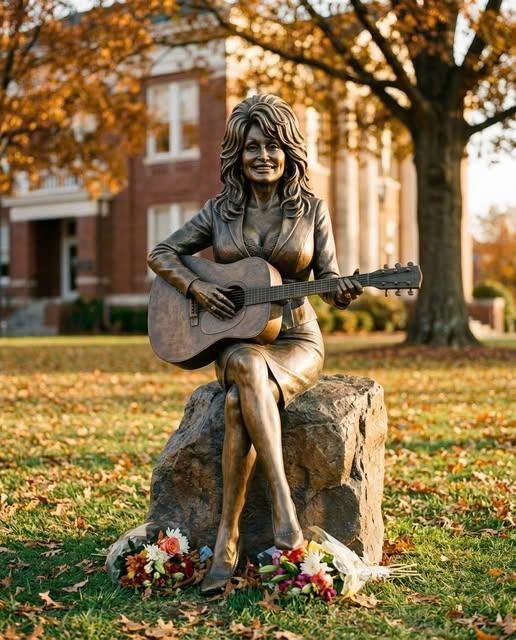
In the heart of Sevierville, Tennessee, a bronze statue of a barefoot young Dolly Parton has greeted her hometown for years. Sitting peacefully with her guitar in her lap on the courthouse lawn, the statue captures an image of the local girl who once dreamed of a life far beyond the small mountain town. Today, it stands not simply as a monument to a famous musician, but as a symbol of dreams, determination, family, and the deep connection between an artist and the place where she began.
Dolly Parton was born in 1946 in a small cabin in the Great Smoky Mountains of Tennessee, not far from Sevierville. She grew up in a large, close-knit family with very limited financial resources. Music, however, was always part of her world. Her mother sang traditional songs, while her father and other relatives helped create a home filled with stories, melodies, and faith. From an early age, Dolly discovered that music could become a way to express her feelings, tell stories, and imagine a different future.
The young Dolly began performing while she was still a child. She appeared on local radio and television programs and eventually traveled to Nashville to pursue her ambitions. Her journey was far from easy. The music industry was competitive, and success required not only talent but also extraordinary persistence. Yet the girl from the Smoky Mountains continued writing songs, performing, and developing her own distinctive voice. Over time, she became one of the most recognizable figures in country music, known not only for her singing and songwriting but also for her warmth, humor, and generosity.
That makes the bronze statue in Sevierville especially meaningful. The artist depicted Dolly as a young, barefoot girl holding her guitar, rather than as the internationally celebrated star she would later become. The choice reminds visitors that every extraordinary journey begins somewhere ordinary. Before the glamorous performances, awards, television appearances, and worldwide recognition, there was simply a young girl with a guitar and a dream.
The courthouse lawn also gives the statue a special sense of place. It is surrounded by the everyday life of the community that Dolly once knew. People pass by, visitors stop to take photographs, and residents can see the statue as part of the town itself. Rather than placing her memory in a distant museum, Sevierville keeps Dolly close to the people and landscape that shaped her early life.
For many visitors, the statue represents more than nostalgia. It tells a universal story about believing in possibilities even when circumstances seem limited. Dolly Parton’s journey from a modest childhood in East Tennessee to international fame has inspired generations of people to pursue creativity while remaining connected to their roots.
The barefoot girl on the courthouse lawn therefore seems to be looking toward a future that only she could imagine. Her guitar rests in her hands, her hometown surrounds her, and her story remains deeply connected to the mountains of Tennessee. The statue quietly reminds everyone who passes by that big dreams can begin in small places—and that no matter how far a person travels, home can remain an important part of the journey.