Watch the video at the end of this article.
Introduction
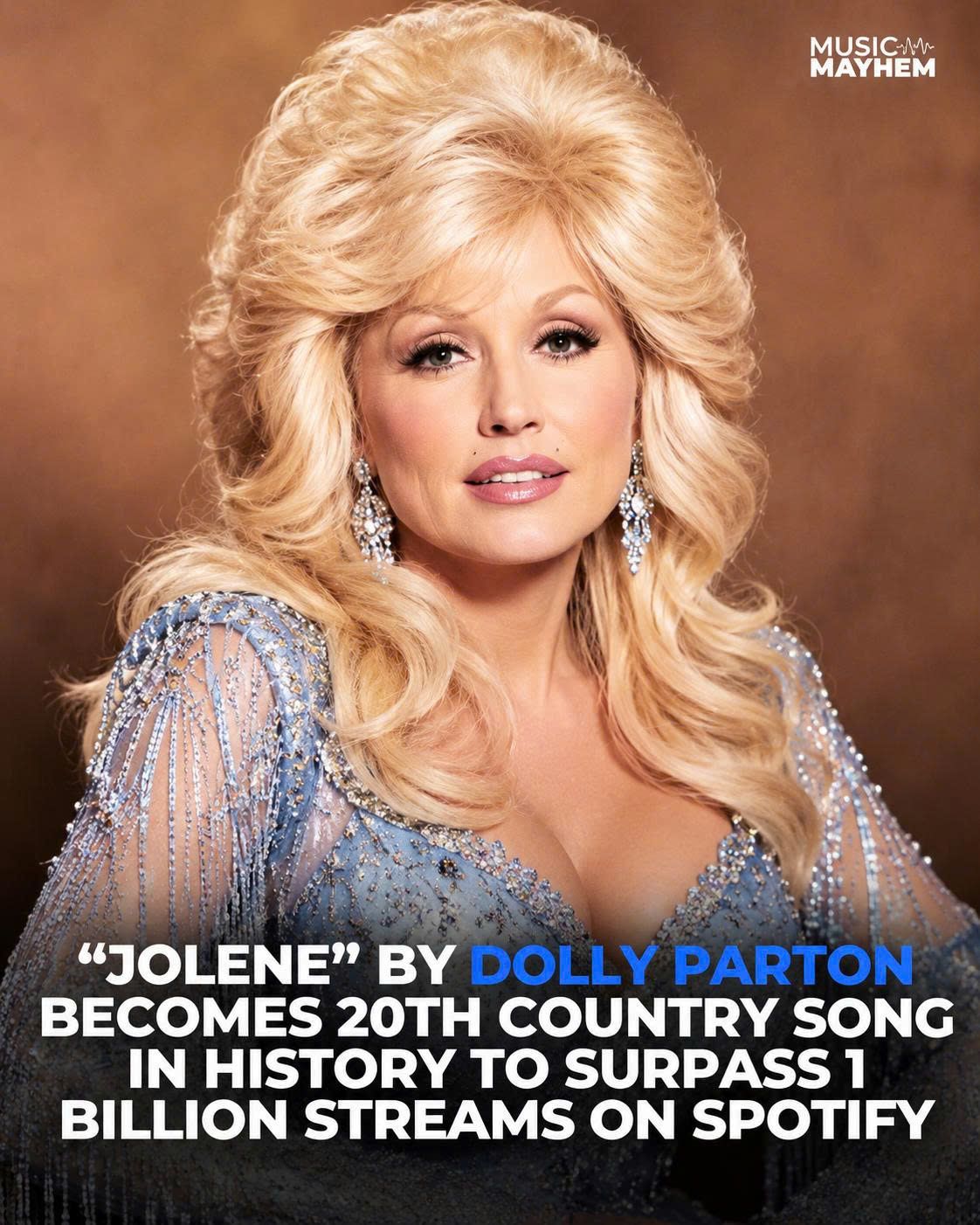
“Jolene, Jolene, Jolene, Jolene…” Few opening words in country music history are as instantly recognizable as these. More than five decades after Dolly Parton first recorded her timeless classic “Jolene,” the song has reached another remarkable milestone: it has officially surpassed one billion streams on Spotify, becoming the first song in Parton’s legendary discography to achieve that extraordinary number. The achievement is more than a streaming statistic; it is a powerful reminder of how a deeply personal country song can transcend generations, borders, and changing musical tastes to remain emotionally relevant decades after its release. Written and recorded by Parton in 1973, “Jolene” captures a moment of vulnerability that feels remarkably intimate. In the song, a woman desperately pleads with another woman, Jolene, not to take the man she loves. Rather than presenting herself as confident or invincible, the narrator openly admits that she is frightened by Jolene’s beauty and charm. That emotional honesty is one of the reasons the song has remained so compelling. Parton does not sing from a place of anger or revenge. Instead, she sings from fear, insecurity, and love, creating a character whose vulnerability listeners can immediately understand. The name “Jolene” itself became unforgettable, repeated throughout the chorus like a desperate prayer. Parton has explained that the inspiration for the song came from real experiences, including a flirtatious red-haired bank teller who caught her husband Carl Dean’s attention and a young fan named Jolene who once approached her after a performance. Those stories helped shape a fictional narrative that ultimately became one of country music’s most enduring songs. Musically, “Jolene” is deceptively simple. Its driving rhythm, memorable guitar work, and Parton’s distinctive voice create tension from the very beginning. Her vocal performance moves between sweetness and desperation, making every repetition of Jolene’s name feel increasingly urgent. The arrangement never overwhelms the story; instead, it leaves space for the lyrics and emotion to take center stage. That simplicity helped make the recording accessible not only to country audiences but also to listeners who might never have considered themselves country-music fans. Over the years, “Jolene” has been covered, reinterpreted, sampled, and celebrated by artists from different musical backgrounds, further demonstrating its extraordinary cultural reach. Yet the original remains special because of Parton’s unmistakable personality and storytelling ability. Her voice turns a simple plea into a universal portrait of romantic insecurity. The song can be heard as a story about jealousy, but it is equally a story about recognizing one’s own vulnerability and asking another person for compassion. Reaching one billion Spotify streams in the modern digital era gives “Jolene” a fascinating connection between country music’s past and present. A song recorded in the early 1970s, long before streaming existed, has found an enormous audience on one of today’s biggest music platforms. For Parton, whose career has already influenced generations of musicians and fans, the milestone adds another chapter to an extraordinary legacy. “Jolene” proves that great songwriting does not depend on technology or trends. A heartfelt story, a memorable melody, and an unforgettable voice can continue speaking to people long after the original recording was made. More than fifty years later, listeners are still singing the same four words: “Jolene, Jolene, Jolene, Jolene.” And now, one billion streams later, the world has another reason to celebrate Dolly Parton’s enduring musical magic.